Follow the Money: How to Find Clients & Structure Deals for Freelance Success
by Miranda Miller

Ah, the freelance life… lazing on the beach, trying not to tip the hammock as you reach for that one last piña colada you’ll allow yourself before settling in for your two hours of afternoon writing.
Or maybe you’re the type of freelancer who bakes all day, between keeping a spotless house and nurturing impeccable gardens, with all that time you spend at home.
Okay, time for a reality check.
So, About That…
In truth, the vast majority of people who have left the 9-5 grind in search of this idyllic freelance life have quickly learned that it’s not all sunshine and lollipops. Internet gurus promise vast riches in a 10-hour work week, but in truth, only the top 19% of American freelancers make $50,000 or more, including the 5% of freelancers smashing through the six-figure ceiling.
Read the rest of this post »
Off The Wire: News for the Canadian media freelancer Oct 20-26
Once a week, we gather stories about the media business, journalism, writing, publishing, and freelancing—with a Canadian focus—and share them in Off the Wire. Who needs a water cooler?

From Canada:
- Postmedia cancels evening tablet editions [J-Source]
- Postmedia targets cost-cutting as it seeks new revenue streams [Globe and Mail]
- New research: print magazine readers outnumber digital 2 to 1 [Magazines Canada]
- Freed Canadian journalist Mohamed Fahmy sets sights on change [J-Source]
From The U.S. and beyond:
- As reporter networks fragment, startup seeks to fill gap [Poynter]
- Why I Hired an Editor to Help Me Polish My Personal Essay [The Write Life]
- Working From Home: Awesome or Awful? [The Atlantic]
- Can WordRates Help You Earn More Money as a Freelance Journalist? [The Write Life]
- Why HuffPo and other ‘new’ media journalists are choosing unions [The Conversation]
- 25 Things You Should Probably Outsource [The Freelancer]
- Story dust: Lessons learned on feature writing from Lane DeGregory [Poynter]
- Vice blacks out homepages and social media to call for the release of journalist Mohammed Rasool [Nieman Lab]
- How to Use the Pomodoro Technique as a Freelance Writer [The Write Life]
- Why some promising freelance platforms fail [IJNet]
Last week on Story Board:
- Ali Mustafa Memorial Award for freelance photojournalists application deadline Nov. 1: A new award honouring a freelance photojournalist killed in Syria is now accepting applications. The deadline to apply for the first annual Ali Mustafa Memorial Award for People’s Journalism is Sunday, November 1st…
- Debate on unpaid internships still evolving: The past few years have seen a crackdown on corporations and organizations that are still hiring unpaid interns. Despite the pushback, there is still a demand for internships, most unpaid…
- Keeping in touch with clients: The client put my business card on his desk. He had held onto it since 2003, after we had worked together on a safety newsletter. That’s right, since 2003. I was stunned…
Spot a story you think we should include in next week’s Off the Wire? Email the link to editor@thestoryboard.ca or tweet us at @storyboard_ca.
Ali Mustafa Memorial Award for freelance photojournalists application deadline Nov. 1
 A new award honouring a freelance photojournalist killed in Syria is now accepting applications. The deadline to apply for the first annual Ali Mustafa Memorial Award for People’s Journalism is Sunday, November 1st.
The award is given in honour of Ali Mustafa, a Toronto freelance photojournalist who was killed in Aleppo in March 2014 while he was photographing the destruction caused by the war in Syria. His work had been featured in The Guardian, Le Nouvel Observateur, Journal du Dimanche, Les Echos, and The Times of London. He was only 29 years old when he was killed.
The award was set up by the Ali Mustafa Memorial Collective as a way to honour his memory and pay tribute to the work of freelance photographers. It seeks to support freelance photographers who are documenting social justice-related issues.
The winner of the award will receive a maximum of $3,000 to cover such costs as travel expenses, equipment, training, visa, insurance, and living expenses. The winner will also be given a one-year membership in the Canadian Media Guild’s Freelance Branch and a one-year professional membership in the News Photographers Association of Canada.
For more details about the award and how to apply, visit rememberinalimustafa.org. If you have any questions, you can send them to AliMustafaAward@gmail.com.
Debate on unpaid internships still evolving
Toronto panel discusses why, despite crackdowns, unpaid internships remain all too common.
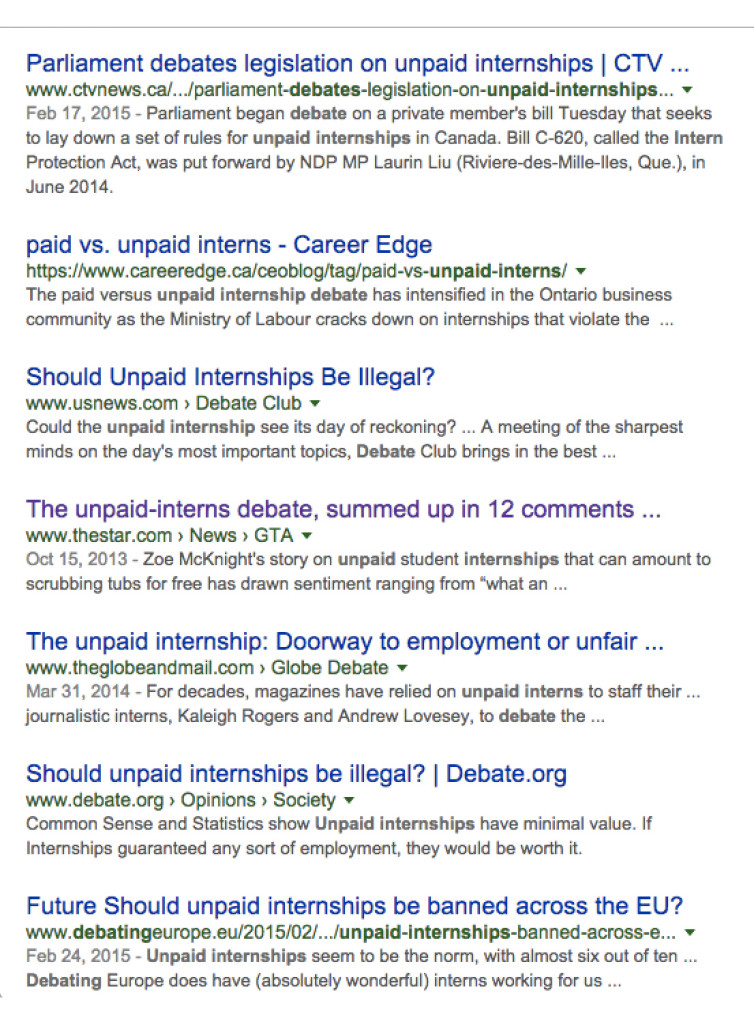
Despite outcry over unpaid internships, people continue to debate their merits. Screenshot by J-Source.
By Marielle Torrefranca
The past few years have seen a crackdown on corporations and organizations that are still hiring unpaid interns.
Despite the pushback, there is still a demand for internships, most unpaid. Why is the demand still so strong?
That was the main question under discussion at Interns, Connect! A Forum on Upsetting Unpaid Work. The event was held in conjunction with the launch of a special issue of the open-access journal tripleC called Interrogating Internships: Unpaid Work, Creative Industries, and Higher Education.
The two-hour panel took place at the Centre for Social Innovation Annex in Toronto on Thursday, Sept. 24 and featured Andrew Langille, a labour lawyer and general counsel for the Canadian Intern Association; Josh Mandryk, director of the Canadian Intern Association; Jainna Patel, a former intern for Bell Mobility; Katherine Lapointe, an organizer of the CWA Canada’s Associate Member’s program; Deena Ladd, founder and coordinator of the Workers’ Action Centre; Carlo Fanelli, a visiting professor at Ryerson’s Department of Politics and Ella Henry, co-chair of Students Against Unpaid Internship Scams.
Under the moderation of Toronto Star’s Work and Wealth reporter Sara Mojtehedzadeh, each panellist noted that the state of the “intern issue” is in need of a fresh direction.
Are you keeping in touch with clients?
by Sue Horner
The client put my business card on his desk. He had held onto it since 2003, after we had worked together on a safety newsletter.
That’s right, since 2003. I was stunned.
As a writer, I’m thrilled to be invited to quote on new projects with someone I have worked with before. As a business owner, though, I’m embarrassed that *I* had not contacted him in all those years, just to keep in touch.
It’s true we might have lost touch anyway. He had changed companies, and the original colleague who connected us was now using an agency instead of me. But as any business owner knows, it’s easier and more pleasant all around to do more work with existing clients than to beat the bushes to find new clients.
Over at the Well-Fed Writer Blog, fellow indie Peter Bowerman described a similar situation, wondering why we lose contact with customers. He agrees there are lots of reasons why we might not work with a client any more, all of which have happened to me:
Read the rest of this post »
Off The Wire: News for the Canadian media freelancer Oct 14-19
Once a week, we gather stories about the media business, journalism, writing, publishing, and freelancing—with a Canadian focus—and share them in Off the Wire. Who needs a water cooler?
From Canada:
- Which Party Cares About Freelancers? The Election Issue [Living Freelance]
- Canadians must demand better journalism, says CBC’s Derek Stoffel [J-Source]
- CJFE Press Conference with Mohamed Fahmy in Toronto [J-Source]
- Memo: Amanda Lang to leave CBC [J-Source]
From The U.S. and beyond:
- Meet the new ‘Yelp-like’ app for freelance writers [New York Post] (via @Romenesko)
- Key advice for young writers getting started in games journalism [Journalism.co.uk]
- 9 Things Freelancers Should Do To Get Higher Rates [Fast Company]
- How the most successful people keep track of their best ideas [Fast Company]
- How NOT to write a pitch email [Freelancers Union]
- Working on the Road: 4 Tips for Freelance Writing While Traveling [The Write Life]
Last week on Story Board:
- The Born Freelancer on Whether or Not to Believe: I was talking with a colleague recently. We were comparing notes about the freelancing life and duly complaining about this and that, when out of the blue he said, “Well, it’s not so bad for you, at least you always believe in what you’re working on”…
- Scott Carney’s WordRates to launch on Monday: Last spring we told you about the Kickstarter for WordRates, a website aimed at improving rates and working conditions for freelance writers. Since his successful Kickstarter ended, Colorado-based writer Scott Carney has been working with developers to bring WordRates to life…
Spot a story you think we should include in next week’s Off the Wire? Email the link to editor@thestoryboard.ca or tweet us at @storyboard_ca.
The Born Freelancer on Whether or Not to Believe
This series of posts by the Born Freelancer shares personal experiences and thoughts on issues relevant to freelancers. Have something to add to the conversation? Your input is welcome in the comments.
I was talking with a colleague recently. We were comparing notes about the freelancing life and duly complaining about this and that, when out of the blue he said, “Well, it’s not so bad for you, at least you always believe in what you’re working on”.
When I asked him to explain, he replied, “Well, I have all the same problems you do but rarely get the satisfaction of having dealt with them for something I believe in”. In other words, he was a true “gun for hire”. He didn’t necessarily have to believe in the project he was working on. As a result he had far more work and far more revenue streams than did I. Now maybe I had more “satisfaction” than he did but how relevant is that to the working freelancer with bills to pay and mouths to feed?
So I got to pondering – do you really need to believe in your work?
Scott Carney’s WordRates to launch on Monday
Last spring we told you about the Kickstarter for WordRates, a website aimed at improving rates and working conditions for freelance writers. Since his successful Kickstarter ended, Colorado-based writer Scott Carney has been working with developers to bring WordRates to life. Last week he announced that the site will launch at 8 a.m. this coming Monday, October 19th.
Carney launched the project in response to the stripping of valuable rights from freelance contracts at major magazines. He envisioned WordRates as a way to put some power back in the hands of writers.
His site has a dual purpose. The WordRates side will serve as “a Yelp! for journalists,” giving freelancers the opportunity to post information about their experiences with various publishers, including word rates and information about editors. The PitchLab side of the operation will act as a literary agency, pairing writers with mentors to workshop ideas and shop them to top magazines in exchange for a 15% commission.
Last week, Carney revealed the identities of some of his mentors – award-winning writers from The New York Times Magazine, New Yorker, Vanity Fair and Wired including Trevor Aaronson, Vince Beiser, Erin Biba, Charles Graeber, Jonathan Green, Jon Lackman, Robert Levine, Jason Miklian, Luke O’Brien, Neal Pollack, Paul Tullis and Joel Warner.
Contently ran an interview with Carney last week that explores some of the plans for PitchLab. Although the site intends to represent only the very best story pitches they’re sent, Carney hopes that WordRates will have a wider impact. His ultimate aim is to push all writers to be more aware of their value to the businesses that profit from their work.
That’s a goal we can definitely get behind. Check out Carney’s creation next week at Wordrates.com.
Off The Wire: News for the Canadian media freelancer Oct 6-13
Once a week, we gather stories about the media business, journalism, writing, publishing, and freelancing—with a Canadian focus—and share them in Off the Wire. Who needs a water cooler?
From Canada:
- Five reasons Aboriginal journalists are turning to crowdfunding [J-Source]
- CBC introduces bullying helpline for staff in wake of Ghomeshi scandal [Globe and Mail]
- Mohamed Fahmy departs Egypt to begin trip home to Canada [Globe and Mail]
From The U.S. and beyond:
- 9 Things Freelancers Should Do To Get Higher Rates [Fast Company]
- This Startup Will Piss Off Publishers—And Make Freelancers Happy [The Freelancer]
- Commentary: Corporate media’s lack of vision threatens photojournalism’s future [Poynter]
- The 9 Most Important Takeaways From Freelancers Union’s Annual Survey [The Freelancer]
- 30 cranky bits of wisdom on the craft of journalism [Poynter]
- Huffington Post Staffers Seeking to Unionize With Writers Guild [Variety]
- Al Jazeera America digital workers vote to go union [Poynter]
- Why Politicians Better Start Listening to Freelancers [Time]
- You Screwed Up. How Do You Get Your Client Back? [The Freelancer]
- Major TV networks sign onto freelancer safety compact [Poynter]
Last week on Story Board:
- John Vaillant on high-impact non-fiction writing: Master storyteller John Vaillant delivered a highly concentrated dose of non-fiction writing advice last weekend at a day-long workshop in Vancouver that was part of The Tyee’s fall Master Class series…
- SABEW Canada hosts talk with Kevin Delaney: Toronto-area business writers, SABEW Canada is hosting another event this month that you won’t want to miss…
Spot a story you think we should include in next week’s Off the Wire? Email the link to editor@thestoryboard.ca or tweet us at @storyboard_ca.
John Vaillant on high-impact non-fiction writing
 by Rachel Sanders
Master storyteller John Vaillant delivered a highly concentrated dose of non-fiction writing advice last weekend at a day-long workshop in Vancouver that was part of The Tyee’s fall Master Class series.
The author of the award-winning and bestselling books The Golden Spruce and The Tiger took an intense dive into the processes and narrative techniques necessary to create stories that grab and hold readers’ attention in a world filled with distraction. How do you know you’ve got a good story? And where do you go from there? These are questions you need to ask about every story you pitch — from magazine features to radio documentaries to non-fiction books. Here are some of Vaillant’s suggestions.
• So you’ve got an idea… but how do you know whether it’s worth pursuing? Vaillant suggests you use your own barometer of interest. If you’re fascinated by the idea yourself, it’s a good hint that the idea is compelling.
• How much research do you need to do before you’re ready to pitch a story? As much as possible. Vaillant estimates that he spent a year researching before he went to the New Yorker with the story that eventually became The Golden Spruce. When you’re trying to sell a story, you’re basically trying to get a investor, he says. Having solid research material can help with that.
Read the rest of this post »