The 5-Minute Freelancer Q&A #25 — Frances Bula
In this regular feature, Story Board asks Canadian writers to share a few details about their work habits and their strategies for navigating the ups and downs of freelance life.
 Frances Bula knows Vancouver. She covers the city’s wide-ranging urban issues — from drug addiction and prostitution to property development and transportation — for publishers such as the Globe and Mail and Vancouver Magazine. She went freelance eight years ago after spending 20 years on staff at the Vancouver Sun. Bula is also the chair of the Langara College journalism department and an instructor at UBC’s Graduate School of Journalism.
She took the time to speak with Story Board this week about the purpose of journalism, tricking yourself into writing, and developing an instinct for finding good stories.
When you’re just starting out as a writer, is it better to specialize or be a generalist?
I think it’s good for people who are freelancing to work, if they can, at just a general assignment job for a few years. And just perfect their skills and figure out what they like covering. And then move into freelancing. Yes, I’m a person who likes specialization. Even when I wasn’t a freelancer, that’s what I liked. I do think it does give you a certain edge because when you specialize you’re offering the editor an expertise they can’t really get from just any reporter.
And with specializing, you might think “well isn’t the problem that you really narrow what you can write about?” But it doesn’t. Good beat reporters and good niche freelancers know that you can sort of take a basic area and cover the world from Vancouver city hall or a science lab or whatever.
Off The Wire: News for the Canadian media freelancer Dec 1-7
Once a week, we gather stories about the media business, journalism, writing, publishing, and freelancing—with a Canadian focus—and share them in Off the Wire. Who needs a water cooler?
From Canada:
- Important dates for the 2016 National Magazine Awards [Magazine Awards]
- Help update the pay rates for work in factual TV [CMG]
- National Newsmedia Council aims to bring more media into the fold [J-Source]
- S&P cuts Postmedia’s credit rating, warns capital structure “unsustainable” [Globe and Mail]
- Uncivil Dialogue: Commenting and stories about Indigenous people [J-Source]
From The U.S. and beyond:
- Why I stopped calling myself a “freelancer” [Fast Company]
- Struggling authors applying for emergency funds in record numbers [The Guardian]
- Huffington Post joins the union movement – but what about their freelancers? [Freelancers Union]
- Don’t Let This Small Mistake Ruin Your Personal Essay Pitch [The Write Life]
- Glenn Greenwald Talks Freelancing and the Future of Investigative Journalism [The Freelancer]
- 4 must-dos for freelancers before the holidays take over [Freelancers Union]
- Huffington Post the Latest Web Publication to Unionize [Newsweek]
- ‘Overwhelming majority’ sign up for union at Huffington Post, ask for voluntary recognition [Poynter]
- Free spec work? Watch people in other industries say no to spec [Freelancers Union]
- 5 Veteran Freelancers Reveal Their Best Negotiating Tips [The Freelancer]
Last week on Story Board:
- Media workers gather in Louisville to plot path to better workplaces: In early October, journalists, labour organizers, activists and academics converged in Louisville, KY, at the Media Workers Unite Founding Convention to discuss industry-wide campaigns to organize media workers…
- Content Marketing Needn’t be an Ethical Quandary for Canadian Freelancers: In my last column, we looked at “following the money;” at the need for Canadian freelancers who want to continue writing and editing as a career to consider new types of clients…
Spot a story you think we should include in next week’s Off the Wire? Email the link to editor@thestoryboard.ca or tweet us at @storyboard_ca.
Media workers gather in Louisville to plot path to better workplaces
By Errol Salamon
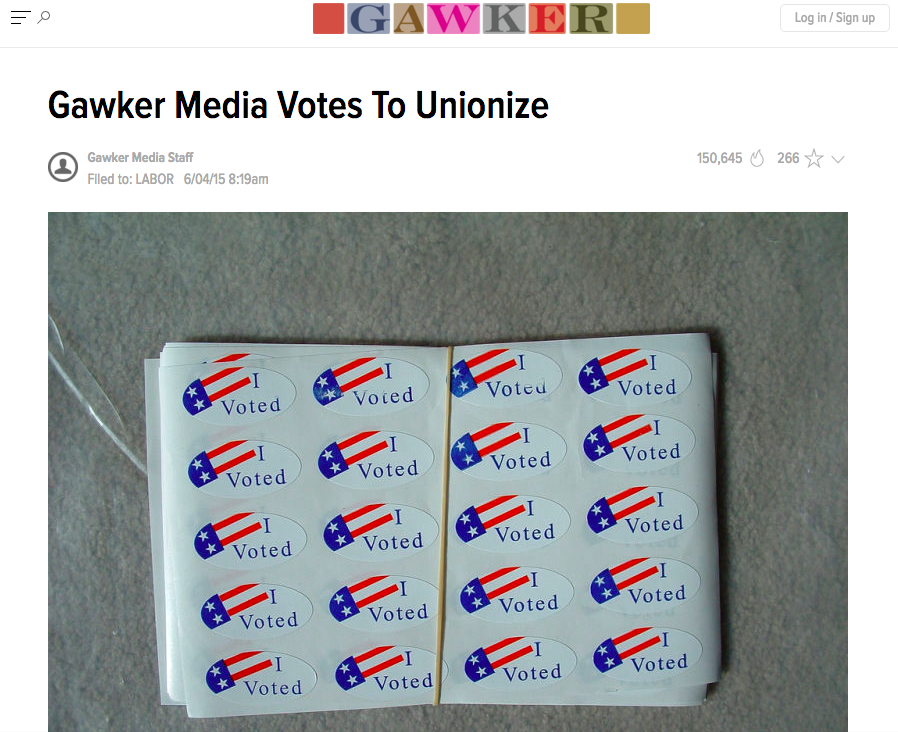
In June 2015, Gawker workers voted to unionize. Now, media workers worldwide are talking about how they can organize their own workplaces. Screenshot by J-Source.
In early October, journalists, labour organizers, activists and academics converged in Louisville, KY, at the Media Workers Unite Founding Convention to discuss industry-wide campaigns to organize media workers.
The convention, held at Nelligan Hall and the Carl Braden Memorial Center, drew about 30 people from the United States, Canada, Australia and Israel to discuss media workers’ rights.
The convention was organized in the midst of an unprecedented wave of unionization among digital journalists in the U.S. Between June and September 2015, editorial employees at six digital media companies voted to join unions.
After Gawker employees voted to join the Writers Guild of America East, others soon followed suit: Salon, Vice and ThinkProgress workers voted to unionize with the Writers Guild, and Guardian US and Al Jazeera America employees voted to become members of The NewsGuild, one of the largest media unions in the country.
The unionization drive continues, as Huffington Post employees are currently organizing. Digital media workers have reportedly sought collective representation to secure ongoing legal protection and improve their working conditions so that they can continue creating high-quality and independent journalism.
Read the rest of this post »
Content Marketing Needn’t Be an Ethical Quandary for Canadian Freelancers
by Miranda Miller
In my last column, we looked at “following the money;” at the need for Canadian freelancers who want to continue writing and editing as a career to consider new types of clients. The trend towards brands as publishers, coupled with the near-universal gutting of mainstream media writing budgets and the devaluation of writing as a skilled trade, is forcing freelancers to look beyond journals, magazines and newspapers as sources of reliable income.
Enter content marketing, the practice of creating content for a company’s audiences — and a contentious topic in some circles, as it turns out.
When the Professional Writers Association of Canada’s Toronto chapter recently held an educational session on content marketing, the group’s listserv lit up in heated discussion on the ethics of content marketing. As a person who has done a good percentage of my business in content marketing, I was surprised by how some felt about it.
In fact, one person declared that content marketing is “one of the absolute worst things ever to happen to newspapers and magazines because it seriously erodes the distinction between journalism and advertising.”
As the conversation continued, there was much debate over the ethics of accepting payment for what some view as the practice of writing advertorials not clearly labeled as such and therefore designed to fool or trick readers.
But is that all there is to content marketing? Not by a long shot.
Read the rest of this post »
Off The Wire: News for the Canadian media freelancer Nov 24-30
Once a week, we gather stories about the media business, journalism, writing, publishing, and freelancing—with a Canadian focus—and share them in Off the Wire. Who needs a water cooler?
From Canada:
- Fahmy on foreign reportage and citizenship rights [J-Source]
- Postmedia brass pocketed bonuses for Sun acquisition [Globe and Mail]
- Digital Publishing Awards launched [J-Source]
- The Unbearable Whiteness of Canadian Columnists [Ryerson Review]
- Call for submissions: Tom Hanson Photojournalism Award [J-Source]
- Canada’s new census needs to capture nuances of fast-evolving economy [Globe and Mail]
From The U.S. and beyond:
- Freelancers give advice on how to screen clients [Fast Company]
- 5 Platitudes that Characterize Freelance Life [LinkedIn] (via @LivinFreelance)
- How freelance journalists can (mostly) avoid working for free [Poynter]
- How to Stay Productive When You’re Working from Home [The Undercover Recruiter]
- How to find community when you work alone [Freelancers Union]
- Smashing the glass ceiling: Advice for women in journalism [Journalism.co.uk]
Last week on Story Board:
- 5 Snapshot Tips from a Master Photographer: Freelance journalists and photographers need to produce photos that sell, photos that stand out from the other 80 million photos that are posted every day to Instagram alone…
- The Journey to a Balanced Freelance Life: Working as a freelancer requires a rare combination of skills. At the top of the list has to be flexibility. Freelancers need to have the unique ability to dance with the uncertainty of what work will show up and when…
Spot a story you think we should include in next week’s Off the Wire? Email the link to editor@thestoryboard.ca or tweet us at @storyboard_ca.
5 Snapshot Tips from a Master Photographer
by Don Genova
The digital age has made taking a photo almost as easy as taking a breath. We shoot from our phones, our tablets, our webcams, and yes, sometimes we even use an actual camera. But freelance journalists and photographers need to produce photos that sell, photos that stand out from the other 80 million photos that are posted every day to Instagram alone.
That’s where Vancouver-based Globe and Mail photographer John Lehmann comes in. On Nov. 21st, CMG Freelance sponsored a Master Class in “Visual Journalism” offered by The Tyee, featuring Lehmann, one of Canada’s top photojournalists.
Over the course of the day-long seminar, Lehmann showed photos from some of his most recent shoots, including three days spent with Justin Trudeau on the campaign trail, and an upcoming series on refugees stranded in Hong Kong, shot entirely on his iPhone.
After sharing some of his basic rules of photojournalism, Lehmann challenged students to edit the photos from two stories he worked on, paring down 700 photos from each session to a mere 14 that we would hypothetically send on to the photo editor at the Globe. It was a daunting task that took us a couple of hours, but one that Lehmann can usually do in ‘five or ten minutes’. Of course, they were his photos, and he already had a pretty good idea of what might become his ‘keepers’ when he started the editing process.
Here are 5 snapshots I took away from the experience:
Read the rest of this post »
The Journey to a Balanced Freelance Life
by Rebecca Hass
Working as a freelancer requires a rare combination of skills. At the top of the list has to be flexibility. Freelancers need to have the unique ability to dance with the uncertainty of what work will show up and when. Often a freelancer will find himself or herself in the land of ‘feast or famine’.
When work comes, most of us say a loud YES! What else can we say when we are so well acquainted with the lean times? Because this is the way freelancing works, life balance can seem impossible for many freelancers. How can one have balance with the schedule and demands of freelancing?
But there is hope tor those of us who burn the midnight oil and can’t seem to stop working the weekends. I have five straightforward steps you can take to move towards the balance you crave.
Step One: Redefine Balance
Balance is often defined as ‘an even distribution’, which is possible if you are buying dried goods at the Bulk Barn. But not in your life. The definition that you need is slightly different. Balance is “a condition in which elements are in the correct proportions.”
Forget balance. You want a life well lived.
Read the rest of this post »
Off The Wire: News for the Canadian media freelancer Nov 17-23
Once a week, we gather stories about the media business, journalism, writing, publishing, and freelancing—with a Canadian focus—and share them in Off the Wire. Who needs a water cooler?
From Canada:
- Survey respondents tell Western mag awards to offer a stripped-down version [Canadian Magazines]
- Stuart McLean cancels Vinyl Cafe Christmas tour due to melanoma [CBC]
- 2015 COPA winners list [Masthead]
- Media workers gather in Louisville to plot path to better workplaces [J-Source]
From The U.S. and beyond:
- Huffington Post employees urge colleagues to join union movement [The Guardian]
- Make the Leap to Full-Time Freelance Writing in 5 Essential Steps [The Write Life]
- Is the freelance economy a social tragedy? [Freelancers Union]
- How to Negotiate Better Rates Even When You Don’t Think You Can [The Freelancer]
- What to do when you’ve overcommitted [Freelancers Union]
- Gawker Media grapples with treatment of female staffers [Poynter]
Last week on Story Board:
- Freelancer meet-up in Victoria on Tuesday, Nov. 24: If you’re a freelancer in the Victoria, BC area, you’re invited to come out to Moxie’s next Tuesday, November 24th at 7:30 p.m. for a casual freelance get-together…
- All media work has value: Notes from the Media Workers Forum: At a time when unpaid internships prevail and precarious employment seems the norm, how should institutions better protect interns, and what can we media workers do to protect ourselves?…
- The Born Freelancer on the Merits of a Freelance Routine: I’ve been told so many times that I must have such great self-discipline (as a freelancer) that I’m beginning to believe it myself. And I guess, to some degree, it’s true…
Spot a story you think we should include in next week’s Off the Wire? Email the link to editor@thestoryboard.ca or tweet us at @storyboard_ca.
All media work has value: Notes from the Media Workers Forum
by Lisa Ferguson
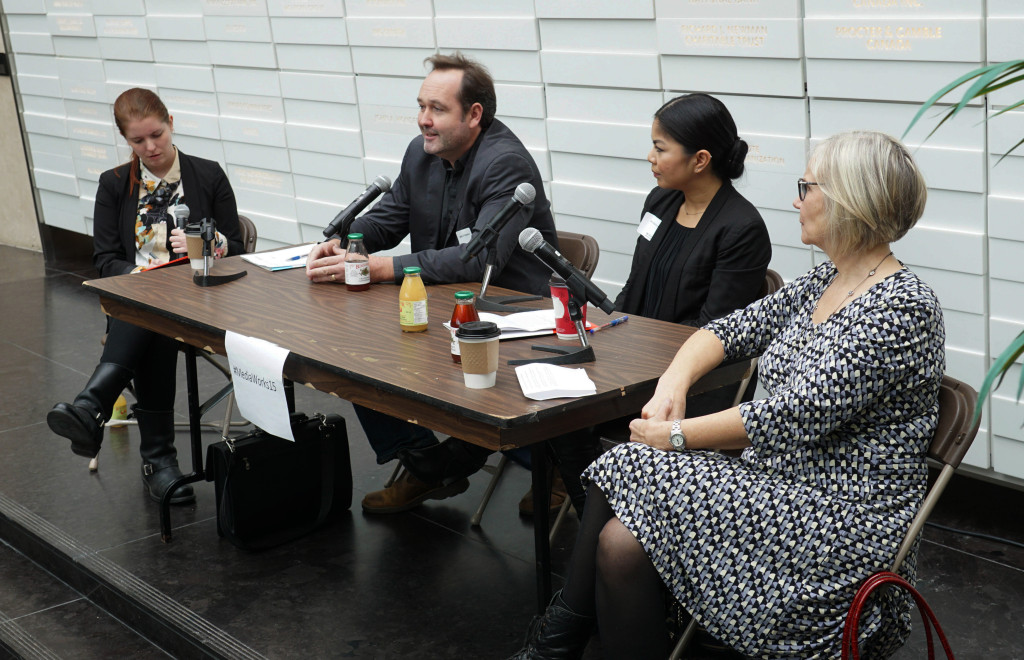
A panel discussion with CWA Canada President Martin O’Hanlon at the Media Workers Forum on November 14. Photo by Aloke Anand
At a time when unpaid internships prevail and precarious employment seems the norm, how should institutions better protect interns, and what can we media workers do to protect ourselves? These questions were the focus of the Media Workers Forum, an event for CWA Canada Associate members — student, aspiring and precarious (intern, temporary, part-time) media workers — in Toronto on November 14.
The consensus was that despite having different goals, unions, journalism schools, and employers should all work to create quality internships in the media.
- CWA Canada President Martin O’Hanlon said the union’s goal is to protect interns, and it has taken a position against unpaid internships “because we believe young people and journalists should be paid for their work.” But J-schools and media also have a responsibility to expose injustice, he said, and J-schools should take the stance of being against unpaid internships. CWA Canada’s paid internship agreement with The Canadian Press is an example of how an employer and a union can collaborate to create better student opportunities.
- Joan Antonio, Program Manager for the M-School magazine internship program at Rogers Media (launched in May 2013), said that because they want to produce quality content and tap into young talent, Rogers needed to do better than unpaid internships. “While experience alone is valuable, the pay [offered by M-School] is an incentive,” Antonio said.
- Ann Rauhala, an Associate Professor of Journalism at Ryerson University, said the J-school’s goals are to ensure employers send its sought-after, final-year students — who know how to research, write, and shoot — out reporting every day, just as a junior reporter would be. Otherwise, “they don’t get our students again,” she said. While Rauhala said that some of the most useful internships are unpaid, the school has been uncomfortable for years with the “inherent unfairness” of unpaid internships. “At minimum,” she said, “we have to establish some kind of bursary program for students who don’t come from prosperous families.”
If unpaid internships unfairly benefit the privileged, and media organizations use unpaid interns (not to mention user-generated content) to “squeeze every penny out,” how can we ensure that media includes the diverse voices and quality, accurate information that are critical to democratic society?
Read the rest of this post »
The Born Freelancer on the Merits of Routine
This series of posts by the Born Freelancer shares personal experiences and thoughts on issues relevant to freelancers. Have something to add to the conversation? Your input is welcome in the comments.
I’ve been told so many times that I must have such great self-discipline (as a freelancer) that I’m beginning to believe it myself.
And I guess, to some degree, it’s true.
But honestly, that self-discipline ebbs and flows with my energies and emotional well-being.
So, not being able to rely on it 24/7, I find myself relying much more on a concept that seems contrary to the very essence of freelancing.
I refer to “routine”.
Opposites attract?
Freelancing seems to be, in many ways, the exact antithesis of “routine”.
It is never dull, rarely exactly the same twice and often involves unexpected twists and turns.
The word “routine,” on the other hand, seems to belie all of that. Routine sounds so… routine. So banal.